 |
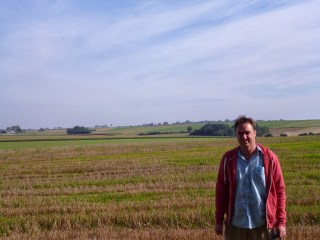
| , France, October 3, 2013 |
I have decided to occasionally add a “Photo of the Day” to my blog to spice it up a little and perhaps throw a cloak of excitement which may otherwise not exist, over my life in an effort to make my blog, and in turn my existence, seem more exciting than it actually is.
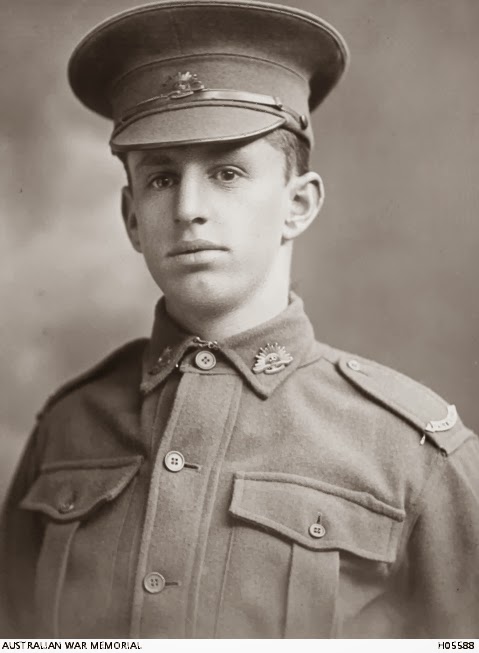 |
| L/Cpl JF Robinson |
I was not originally intending to spend time looking at war memorials and gazing back a century on the pointless destruction inflicted on this part of the world but as I had researched my Great Uncle and learned of his presence in this world, my family was very keen that I visit his grave. As far as we know, no one from the family had ever visited it to pay our respects and let the young fellow know that he had never been forgotten.
She had soon printed out a much better map which showed exactly how to get to Grevillers which was only a few kilometres away but in 1917 would have taken us across No-Man’s Land and I appreciated her effort at rousing herself and displaying some empathy for foreigners who had come from the ends of the earth, just like their forefathers and found themselves in this little village, searching for one of their own.
Taking the advice of our “Bapaume Angels” we were quickly on our way and easily found Grevillers British Cemetery on the outskirts of the village with the same name with only one wrong turn blighting our advance.
Set close to the Albert-Amiens road in rolling green farmland the cemetery is one of literally thousands which dot the line of the old Western Front. Every few miles a cluster of marble headstones will appear along the roadside, testament to the sacrifice of millions of Allied servicemen of the great war and a scar on the landscape; a beacon for the folly of ignorant politicians and the arrogance of Generals who did their bidding.
Grevillers cemetery is beautifully kept as all Commonwealth War Graves cemeteries are. Stark against it’s surroundings, clean and bright, crowned by a memorial to the New Zealand Expeditionary Force which recaptured the town after it was lost to the Allies in the last great German offensive of the war in 1918.
It contains about 400 graves. Kiwis, Brits and Aussies all lie here in geometrically perfect lines with identical headstones laid out with regimental precision.
German fatalities buried here after the Kaiser’s army captured the town were evicted not long after their living comrades were sent packing. Such is the lot of the defeated, dead or alive.
Of course, for me, Grevillers cemetery is different to the rest for an important reason.For in it lies someone who was once of my flesh and blood.
Finding the cemetery was a surreal experience. After all the years of searching, the time spent looking at maps and peering at my destination through Google street view, I was finally here. Now I had to find the man I had travelled so far to see.
Parking at the south-eastern corner, close to where the local farmer was ploughing his field, we entered the cemetery from the rear, close to the Kiwi memorial and a relief plaque dedicated to the history of the Battle of the Somme.
I rushed back to the car, much to Linda’s bewilderment, to retrieve my six-foot Australian flag. It has been to Gallipoli and been carried along the Kokoda Track. I needed it in Grevillers cemetery.
Row by row we searched, Linda on one side of the cemetery, me on the other. I urged young John to help me find him, to guide me to his last resting place. I think he heard me.
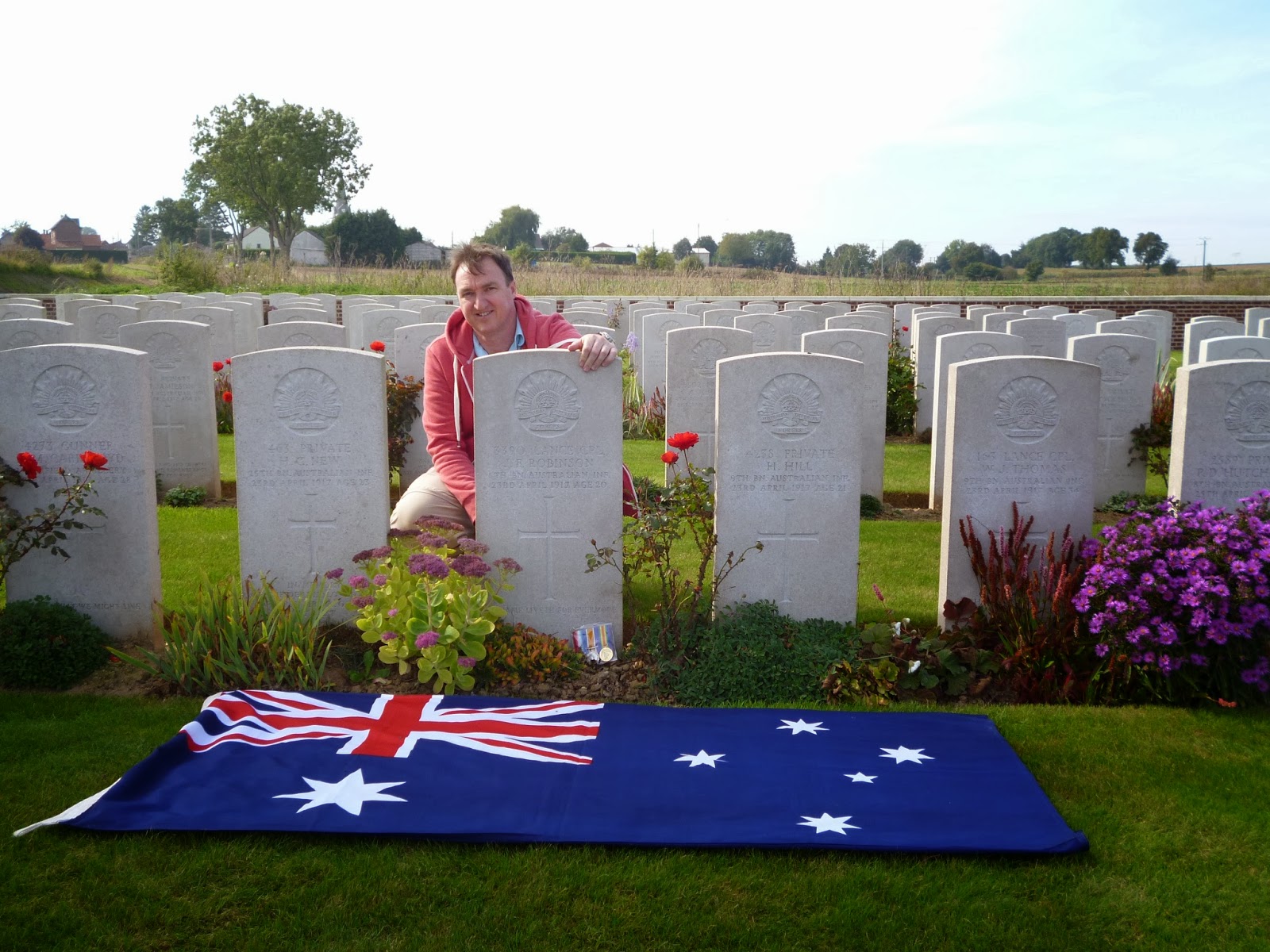
At the very front of the cemetery, next to the Grevillers road, I finally came across a group of soldiers who had died on the day I was looking for. April 23, 1917. Right in the middle row, five or so plots from the entrance, I found him.
Lance Corporal John Flinders Robinson
5th Battalion Australian Imperial Force
23rd April 1917
Aged 20 years
His Name Liveth Forever More
I spread my Australian flag at the base of the headstone and carefully laid a set of replica medals, directly corresponding to those Lance Corporal Robinson would have been awarded posthumously, against the marble.
Photos were taken. Linda and I shared the moment. My family’s duty was fulfilled.
At the entrance of the cemetery, in it’s own little pigeon-hole in the brick facade, is a guest book. There, the names of a regular trickle of visitors is recorded for posterity. The last visitors had preceded us by a few days.
Linda entered her name on the record and handed the book to me. That is when the enormity of my mission finally weighed me down.
Overcome by melancholy and the accumulated grief of a family who had lost a son and a life that was cut short before it had reached it’s prime, I cried.
I cried for my Great Uncle and all that he had missed out on by giving his life for “King and Country”. I cried for his mates who lay with him and those who lie in other lonely French cemeteries, lost and all but forgotten by their descendants. I cried for those who are known only to God, secure in unmarked graves and for those who still lie in the fields which spread to the horizon all about me, lost forever.
A plot in a churlish piece of France and a name on a wall in Canberra are all that physically remain of John Flinders Robinson. But in the hearts of those he left behind he remained forever and in the minds of their descendants he will remain forever more.
Lest we forget.
That was merely my first day on the Somme The adventure continued and so will my narrative……at another time.
Have a great day.
 Strange Notations From a Laborious Life