
I was in Melbourne a couple of months ago and walked to the Shrine of Remembrance from my motel in the city. I have been to the Shrine before but many years ago when I was with my father and we followed the Melbourne to Warnambool road cycling race. I was only a boy then.
I would recommend a visit to the Shrine, not just for it’s historical significance but for it’s magnificent architecture and position on the edge of the Melbourne CBD. It’s surrounded by the Botanic Gardens on one side and St Kilda Road on the other but it’s long, straight concourse gives a magnificent view back to the CBD which is well worthwhile. Melbourne is a lovely city.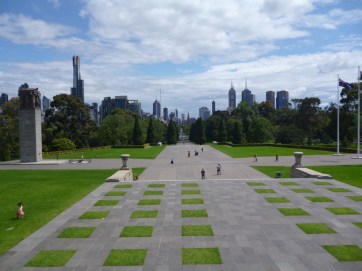
The Shrine was built after the Great War of 1914-18 to honour Victorian servicemen and women who served, fought and died in that conflict and of course veterans of later wars hold their commemorations at the Shrine as well. It plays a major role in Melbourne’s Anzac Day services.
My grandfather and great uncle on my mother’s side and two great uncles on my father’s side have their names recorded in the crypt in the bowels of the Shrine and it was nice to go and see the battalion colours hanging from the ceiling representing every Victorian unit which fought in the First World War.

In the photo above I am pointing to the colour patch of my grandfather’s regiment, the 8th Light Horse. He served at Romani, Gaza, Beersheba and Damascus and made it home in one piece, just a bout of malaria laying him low, only to die fighting a grass fire near his home in Wangaratta two days before Christmas in 1943.
His brother, though younger, joined earlier and served in the 5th battalion AIF, dying of gunshot wounds in the spring of 1917 in a casualty clearing station at Grevillers in France. He was 20 years old.
My father’s uncles served in the Second World War, the elder in the famous 2/7th battalion. Captured by the German army on Crete he spent the rest of the war labouring in a POW camp in Germany itself. His brother, joining later, fought with a militia battalion in New Guinea, notably on the Mubo Track, a campaign described by many veterans as being a harder fight than that on the Kokoda Trail. He died in a car accident a few miles from Wangaratta a few years after he returned home. I guess some young men use up all their luck on the battlefield. Lest we forget.
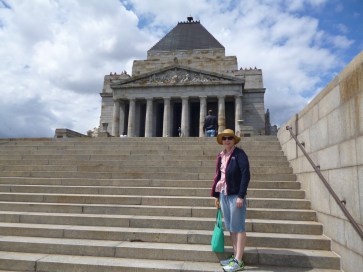
And, this is the Shrine itself for those who haven’t seen it with my lovely partner, Linda on the steps. It’s a significant landmark in Melbourne and a magnificent piece of Victorian and Australian history. Government House is close by and it is only a relatively short walk from the centre of Melbourne. Don’t miss it next time you are in the southern capital.
Have a nice day.
 Strange Notations From a Laborious Life