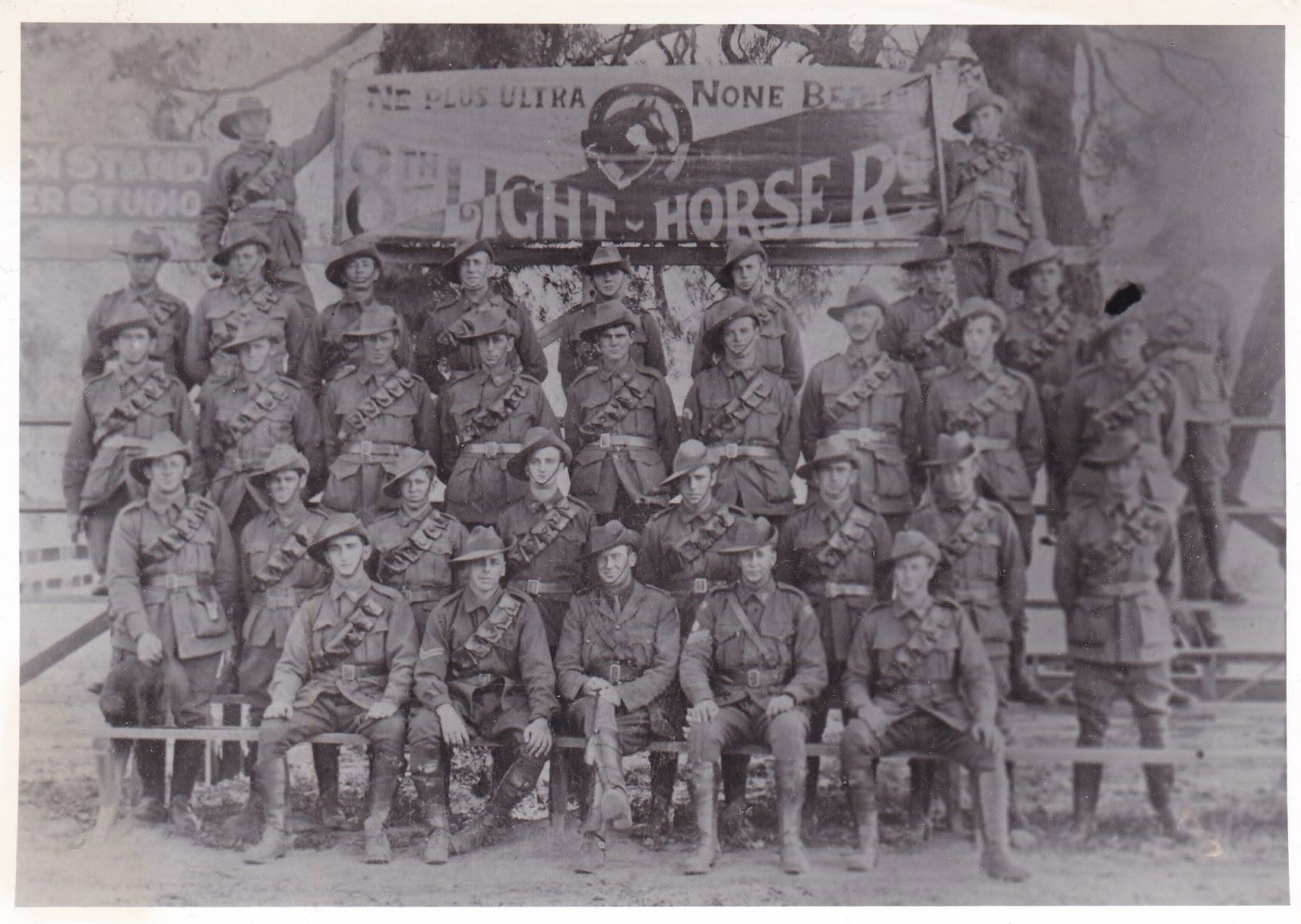
Today’s photo was taken a long time ago. During the First World War. It’s a reinforcement group of the 8th Australian Light Horse Regiment, presumably taken at Broadmeadows camp before their departure to Egypt where they would join the main force of the British army and their Australian colleagues in pushing the Ottoman Empire out of Palestine.
My grandfather, Trooper Norman John Robinson is second from the right, second row from the top (under the banner).
Today is the anniversary of the Battle of Beersheba, the final stage of an operation to seize Gaza, a place still very much in the news today. The operation was succesful.
It’s not the forum to dissect the Battle of Beersheba or why it was important in the greater battle for Gaza or the wider war in the middle east or the complications arising from it that are still being felt in the region today.
Beersheba is famous in Australia today for the great, mounted charge pushed home by the 4th Australian Light Horse Brigade through artillery and machine gun fire which took the town by storm, against the odds.
It made the Australian Light Horse famous forever.
My grandfather was present with the 8th regiment at Beersheba. No glory for them. They weren’t part of the charge. They were on the peripheries and did some hot work on the flanks. In fact, their commanding officer was killed during the days fighting. It must have been a surprise to reach Beersheba and find the 4th brigade already watering their horses.
Military history isn’t everyone’s cup of tea. Plenty of people find it difficult to take an interest in. That is their choice. But a day like today it’s worth remembering our countrymen, our ancestors and men like my grandfather from towns and farms across Australia who poked a little hole in the fabric of history and wrote a note for themselves and Australia in blood outside a little town in Palestine.
Lest we forget.
(Author’s note: 35 Australian and many Turkish soldiers were killed at Beersheba. I salute them all and commend their gallantry today. And the horses. The many horses.)

